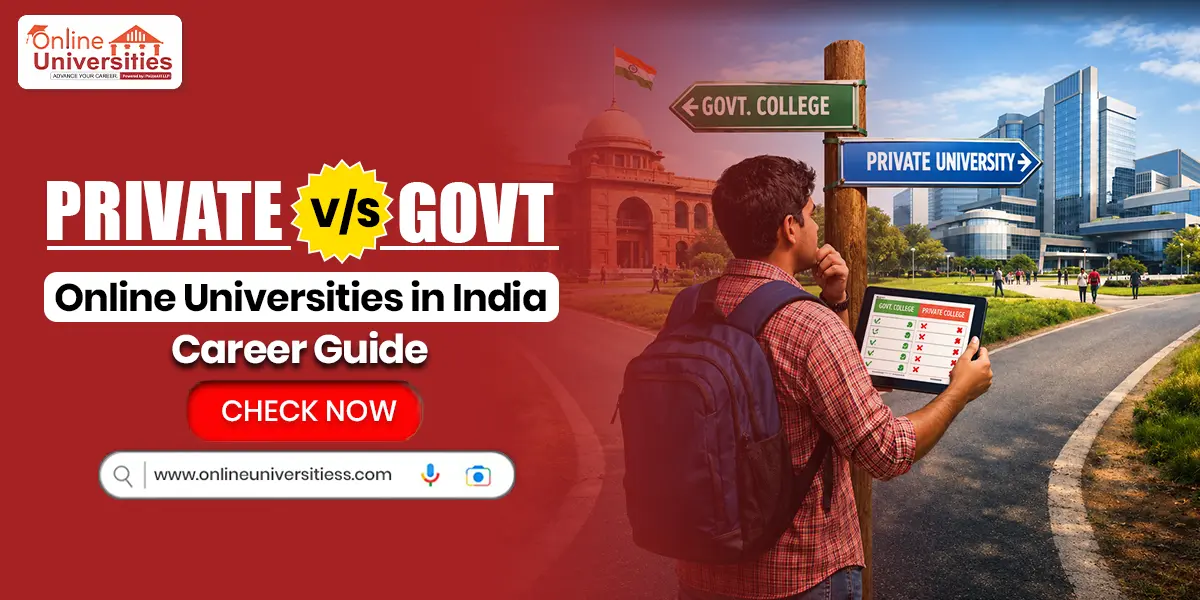
With the mainstream acceptance of online education in India, the discussion between the private and government online universities has gained momentum in 2026. With the changes in policy that makes online degrees equivalent to those granted by recognized institutions, there is now a new trend of students weighing their options based on affordability, flexibility and career outcomes rather than a traditional reputation alone.
The online universities of the government remain on the top with regard to the trust and affordability. Educational institutions such as IGNOU and the School of Open Learning at Delhi University have been the preferred choice due to their affordability and popularity. The government online programs could cost as less as ₹6,000 to 50,000 annually thus affordable to students with different economic backgrounds.
The universities are also quite popular when it comes to government employment and competitive tests and therefore they have a benefit in the aspect of credibility. Nevertheless, they tend to be underrepresented in terms of the current learning environment and placement services, with rather primitive digital infrastructure and poor exposure to the industry.
Conversely, online universities owned by individuals are fast gaining ground by providing courses that are aligned to the industry and rich learning experiences. Amity University Online, Chandigarh university online and other institutions are investing heavily in digital platforms, live classes, and skill-based programs in the areas of data science, artificial intelligence, and digital marketing.
Although the fees are considerably higher, the range of ₹50,000 to more than ₹2 lakh per year, these universities offer excellent placement services, international exposure, etc. and are thus appealing to career-oriented students.
The other important difference is in the flexibility of curriculum. Compared to publicly funded universities, private universities are more likely to respond to changes in industry demand, especially in the more recently developed fields of AI and fintech. By contrast, government institutions tend to have a more traditional and research-driven strategy, which can be more difficult to develop.
The enrollment patterns also indicate that online education is becoming more popular in general. In 2026, India will surpass 50 lakh online learners with Tier 2 and Tier 3 cities major contributors to this figure with flexibility and accessibility. This influx has increased the competition among the private and the public institutions in order to attract students.
With the digital education ecosystem in India still in its developmental phase, both sectors are likely to play an important role in the future of higher education in India by providing students, you opportunity to connect to Online Universities for free career counselling. With a wide range of avenues towards success in an ever-competitive job market.